
TL;DR – Technical Executive Summary
Modern public K-12 administration requires a specialized, fully integrated digital backbone. Implementing a cohesive suite of school district erp hris sis software systems is no longer optional; it is a critical mandate for operational survival. Unlike standard corporate environments, public school districts operate under rigid fund accounting rules, multi-layered union collective bargaining agreements, and strict student privacy compliance. A high-performing school district erp system examples framework demonstrates how centralizing general ledger accounting, payroll distributions, personnel certifications, and student rosters eliminates administrative friction, mitigates compliance risks, and ensures that every tax dollar is directly mapped to classroom enrichment and student success.
DL;DR – Deep Logic & Detailed Review
A deep architectural audit reveals that the most prominent administrative failures in public education stem from fragmented, legacy databases. The key to mitigating these challenges lies in a highly modular, inter-connected system architecture. By deploying comprehensive school district erp system components, districts establish a single source of truth across three critical operational pillars: Finance, Human Capital (HRIS), and Academics (SIS). Through automated relational mapping, real-time data flows from employee credentialing databases directly into payroll allocation engines. This deep integration prevents structural deficits, automates localized grant reporting, and simplifies complex state audits. Evaluating and implementing the best erp software for schools requires aligning technical scalability with municipal integration protocols and union contract rules, ultimately transforming district operations from reactive firefighting into highly optimized, predictive planning.
1. The Administrative Landscape: Public Education’s Silent Crisis
Public school districts are among the most complex administrative entities in the modern municipal ecosystem. They function simultaneously as massive hospitality operations (serving millions of student meals daily), high-capacity transit agencies (routing bus fleets across complex regional grids), real estate management firms (maintaining dozens of aging school structures), and, most importantly, hubs of academic excellence. Yet, behind the scenes, many school systems are crippled by a silent crisis: fragmented, legacy administrative technology.
For decades, districts have relied on disjointed, siloed applications to run their primary business units. The finance department utilizes one legacy system, the human resources office operates another, and individual school campuses manage student enrollment on a third, completely incompatible database. This massive fragmentation results in staggering administrative drag, data redundancy, and a high risk of systemic errors. When a teacher’s certification status changes, or a student transfers from one campus to another, the administrative adjustments must be manually entered across multiple disjointed platforms, increasing labor costs and introducing substantial room for human error.
To solve this massive challenge, forward-thinking districts are turning to unified, public-sector-specific enterprise resource planning platforms. By examining real-world school district erp system examples, superintendents, chief financial officers, and school board trustees can understand how modern technology can harmonize complex administrative workflows. A highly integrated erp software for school environments serves as the central operational brain, connecting every department into a single, cohesive database. When implemented correctly, these enterprise platforms streamline back-office operations, protect public school funding, automate state compliance reporting, and free up valuable resources to be reinvested where they matter most: in classrooms and student development programs.
2. The Architectural Blueprint: Core School District ERP System Components
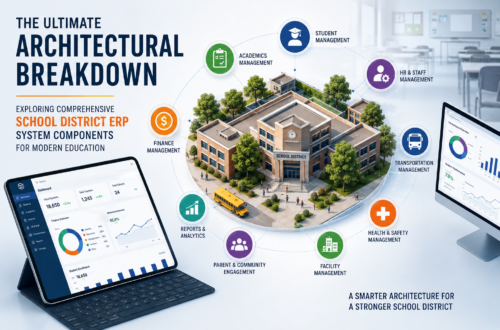
A corporate-grade ERP platform cannot simply be dropped into a K-12 environment and expected to function effectively. Public education requires highly specialized operational modules designed specifically around the unique demands of school boards. To understand how these platforms work, we must dissect the primary school district erp system components that form the structural foundation of a comprehensive district deployment.
A. Fund Accounting and General Ledger
Unlike commercial companies that operate on standard double-entry accounting to maximize profit, public school districts rely on the complex principles of **Modified Accrual Fund Accounting**. Every dollar received by a district—whether from local property taxes, state funding formulas, or federal Title I grants—is legally restricted. It must be accounted for within a specific “fund” and spent only on authorized educational objectives.
A robust school district erp system components architecture must feature a multidimensional Chart of Accounts (COA). The general ledger must track financial transactions across seven or more dimensions, including Fund, Function, Object, Program, Location, and Project. This high-dimensional tracking allows the finance department to generate instant, audit-ready financial reports for state departments of education, proving that restricted grant funding was spent in strict compliance with federal laws.
B. Human Resources Information System (HRIS) & Pension Integration
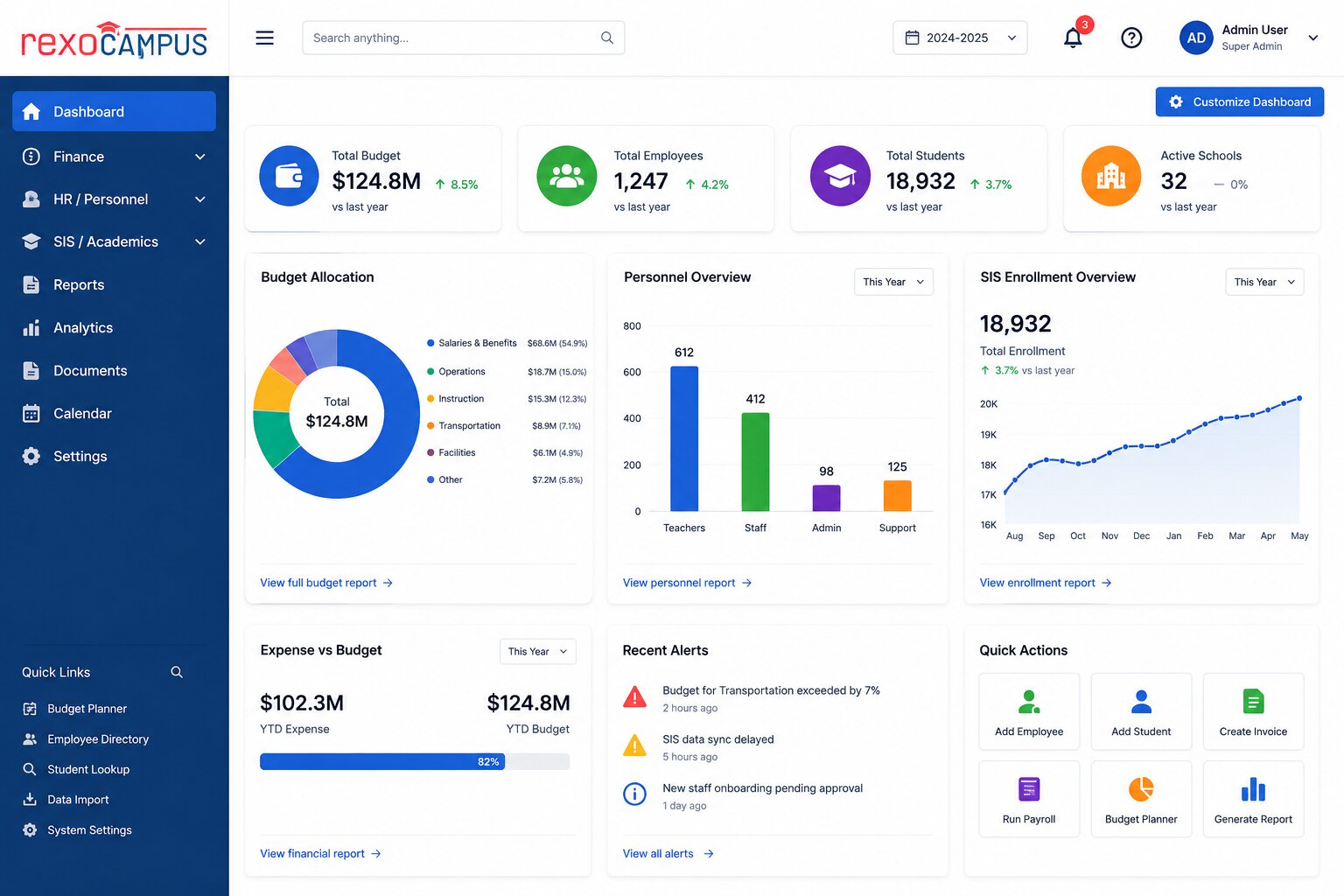
Personnel costs account for roughly 80% to 85% of a typical school district’s annual operating budget. Consequently, managing human capital is the single most critical task of district leadership. A modern school-focused HRIS module does far more than store standard employment contracts. It must manage the incredibly complex rules of public school employment:
- Collective Bargaining Engines: Managing multiple distinct union contracts (teachers, administrators, bus drivers, custodial staff) within a single payroll system. Each contract dictates unique step-and-lane salary schedules, complex longevity bonuses, and highly specific benefits allocations.
- Credential Tracking & Certifications: Monitoring state-mandated teaching licenses, background checks, and professional development hours in real-time. If a teacher’s credential expires, the system must automatically notify HR and temporarily restrict payroll payouts to avoid severe state compliance penalties.
- Substitute Management Integrations: Dynamically linking daily teacher absences with qualified substitute rosters, ensuring that when a substitute step-in occurs, the labor cost is accurately tracked and billed to the absent teacher’s specific school cost center.
C. K-12 Procurement and Spend Analytics
Procuring goods in a public school district is subject to strict municipal bidding laws and competitive sourcing requirements. A high-performance school district erp system components suite provides centralized procurement workflows that automate requisitioning, purchase order creation, and three-way invoice matching. By automating these routines, districts prevent unauthorized “maverick” spending, enforce contract compliance, and aggregate purchasing power across dozens of campuses to negotiate bulk discounts on items ranging from classroom supplies to facility maintenance machinery.
D. Fixed Asset Tracking and Capital Project Management
Districts manage vast physical infrastructure, including school buildings, athletic stadiums, school buses, cafeteria kitchens, and millions of dollars in student technology assets (such as chromebooks and tablets). A comprehensive ERP must track these assets throughout their entire lifecycle—from purchase, assignment, and depreciation, to maintenance and final disposal. Additionally, during multi-year capital construction projects funded by public bonds, the system must track bond allocations, contractor payouts, and construction progress against the approved project budget.
3. The Unified Ecosystem: Integrating ERP, HRIS, and SIS software systems
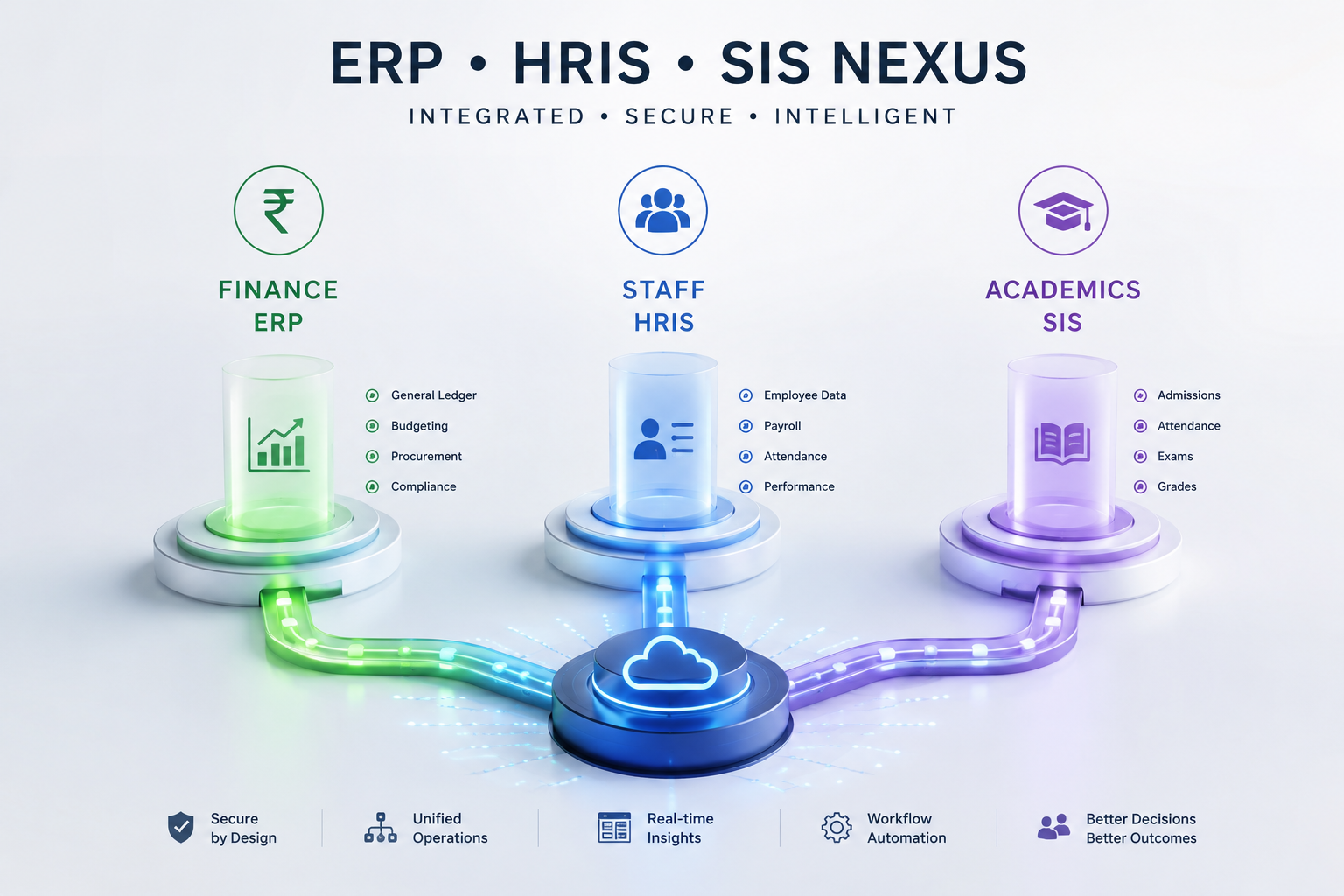
To achieve true operational efficiency, a school district cannot look at its administrative systems in isolation. Instead, leadership must coordinate a unified nexus of three major platforms: the Enterprise Resource Planning system (ERP), the Human Resources Information System (HRIS), and the Student Information System (SIS). The seamless integration of these school district erp hris sis software systems represents the pinnacle of modern school administrative capability.
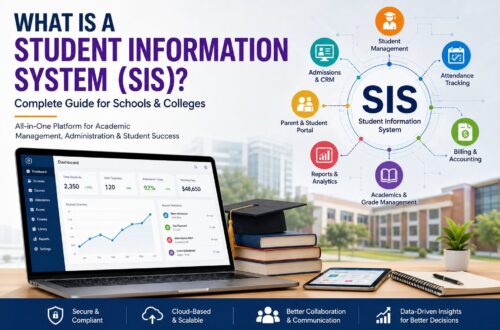
While the ERP manages financial capital and procurement, and the HRIS governs human capital, the Student Information System (SIS) is the primary engine of academic operations. The SIS stores student profiles, tracks daily attendance, manages academic schedules, records grades, and processes disciplinary actions. When these three platforms remain isolated, severe data silos emerge, forcing administrative staff to manually copy data across systems, creating massive delays and statistical discrepancies.
The Lifecycle Flow of a Unified K-12 Database
When a district successfully implements an integrated network of school district erp hris sis software systems, operational events flow seamlessly across departments:
- Personnel Allocation & Class Rostering: When a new student enrolls via the SIS, the system updates class size calculations. If enrollment triggers the need for an additional classroom section, the system automatically queries the HRIS to find available certified staff, calculates the budgetary impact in the ERP, and flags any required funding adjustments for board approval.
- Position Budget Control: Every teaching position must be linked to a specific, budgeted FTE (Full-Time Equivalent) line item in the ERP’s general ledger. When HR hires a teacher, the system automatically checks if the position is fully funded, preventing departments from hiring staff without authorized budget lines.
- Cross-Department Security Access: A teacher’s employment status in the HRIS dynamically governs their software access permissions. If a teacher resigns, the system immediately revokes their grading access in the SIS, terminates their purchasing ability in the ERP procurement module, and disables their network login credentials, protecting sensitive student and financial records.
By connecting student data directly with back-office operations, districts ensure complete operational transparency. For example, pupil transportation modules can link student home addresses in the SIS with district fuel procurement and bus maintenance records in the ERP, generating highly accurate metrics on the true cost per student mile. This level of cross-functional intelligence is only possible when a district commits to deploying the best school erp software designed for complete ecosystem integration.
4. Functional Mechanics: Powering Back-Office Excellence
To truly appreciate the value of a modern K-12 administrative suite, we must look beyond high-level features and examine the daily functional mechanics of a system optimized as a school erp pro platform. These platforms leverage deep automation and employee self-service modules to fundamentally transform school administration, shifting staff energy from paper-shuffling to high-value student support.
A. Position Budgeting and encumbrance Management
In public sector administration, a budget is a binding legal document approved by a school board. If a district overspends its approved budget, it faces severe legal penalties and credit rating downgrades. Modern K-12 ERP software prevents this through a process known as **Encumbrance Accounting**.
When a school principal submits a requisition for new classroom supplies, the ERP doesn’t wait for the invoice to arrive to record the financial impact. Instead, the system instantly calculates the cost and “encumbers” (reserves) that exact amount from the school’s approved budget. If the principal attempts to purchase items that exceed the remaining balance, the ERP automatically blocks the transaction, ensuring the school remains fully compliant with board policy. The system maintains a constant, real-time balance of: Budget – Encumbrances – Actual Expenditures = Available Balance.
B. The Substitute Teacher Payroll Nightmare: Solved
Managing substitute payroll is one of the most painful operational challenges in school administration. Teachers frequently call in sick at the last minute, requiring substitutes with varying pay rates, long-term substitute adjustments, and diverse funding sources. A manual paper-based sub tracking process is highly prone to errors, leading to disgruntled substitute staff and frequent payroll audits.
An advanced school erp pro deployment automates this entire lifecycle. When a teacher registers an absence, the integrated system logs the event. The substitute picks up the shift via a mobile portal. Once the shift is completed and approved by the campus principal, the system automatically pulls the substitute’s pay rate, applies complex long-term pay rules if applicable, maps the expenditure to the correct school cost center, and prepares the transaction for the next payroll cycle, completely eliminating manual data entry.
C. Employee Self-Service (ESS) Portals
In legacy school districts, administrative staff spend hours answering basic employee questions regarding pay stubs, tax forms, accrued sick leave, and benefit options. Modern, unified K-12 ERP suites solve this through secure Employee Self-Service (ESS) portals. Educators and support staff can securely log in to download tax forms, view real-time balances of accrued vacation and sick leave, update direct deposit details, and enroll in benefits programs, greatly reducing the administrative burden on central office staff.
5. Public Sector Realities: Navigating Metropolitan Scale
To fully grasp the magnitude of a district-wide software implementation, it is highly valuable to analyze the operational complexities of a large metropolitan public school district. Large urban public education systems manage budgets that rival mid-sized corporations, employing tens of thousands of educators, administrators, bus drivers, and support personnel. The implementation of a metropolitan-scale **school district erp** system illustrates the extreme demands placed on public sector administrative software.
Consider a large-scale municipal implementation, such as the operational landscape of a baltimore city public schools erp framework. In a metropolitan district of this size, administration must coordinate resources for dozens of school campuses, serving tens of thousands of diverse students, while managing an annual budget exceeding one billion dollars. A system operating at this scale faces severe operational hurdles that standard business software simply cannot support:
- Complex Labor Distributions: Educators in large metropolitan districts often split their teaching time across multiple schools, or split their hours between general classroom instruction and specialized, grant-funded programs (such as federal Title I or Special Education). A robust baltimore city public schools erp system must support split-payroll labor distribution, automatically splitting a single teacher’s salary and benefits across multiple complex funding accounts based on real-time classroom assignments.
- Grant Compliance & Audits: Metropolitan districts receive a massive influx of federal, state, and private philanthropic grants. Each grant comes with strict compliance metrics, requiring detailed documentation of time-and-effort reporting. An enterprise-grade K-12 ERP must automate grant reporting, linking individual employee timesheets directly to the grant accounts and generating instant, transparent audit trails for federal oversight bodies.
- High-Volume Transaction Audits: Processing monthly payroll, managing active vendor files, and tracking thousands of purchase orders requires an enterprise infrastructure capable of handling high transaction volumes without system lag, ensuring that teachers are paid accurately and on time, every single month.
The lesson from large-scale metropolitan deployments is clear: success does not depend on purchasing a flashy commercial brand. Instead, it relies on implementing a platform that features deep, public-sector-centric functionality, a clear roadmap for data migration, and a highly rigorous change management protocol to guide administrative and teaching staff through the technology transition.
6. Strategic Evaluation: Selecting the Best ERP Software for Schools
Selecting a new enterprise administrative platform is a multi-million-dollar, multi-year decision that will shape a school district’s operational efficiency for a decade or more. Making the wrong choice can lead to failed implementations, massive budget overruns, and severe operational disruption. Therefore, district leadership must utilize a structured, highly analytical evaluation process to identify the best school erp for their specific needs.
When searching for the best erp software for schools, the evaluation committee—which should include the Superintendent, Chief Financial Officer, HR Director, Chief Technology Officer, and representative school principals—must look beyond standard software demonstrations. The committee must evaluate vendor proposals against a set of highly rigorous, K-12-specific criteria.
Critical Evaluation Criteria for K-12 Enterprise Software
| Core Dimension | K-12 Specific Requirement | Impact of Failure |
|---|---|---|
| Fund Accounting Integration | Must support modified accrual, encumbrance tracking, and multi-dimensional chart of accounts. | Severe audit failures, loss of state funding, and illegal budget overruns. |
| Collective Bargaining Support | Must native support step-and-lane salary schedules, retroactive pay calculations, and union pension reporting. | Incorrect teacher pay, labor union disputes, and massive payroll reconciliation backlogs. |
| Ecosystem Connectivity | Open REST APIs and native support for Ed-Fi and SIF standards to link seamlessly with the Student Information System. | Data silos, duplicate data entry, and outdated student roster records in administrative modules. |
| K-12 Specialized HR & Credentialing | Real-time tracking of state teaching licenses, background checks, and automated substitute payroll mapping. | Hiring uncertified staff, state compliance penalties, and substitute staffing shortages. |
| Security & Data Privacy | Role-based access controls, SOC 2 Type II certification, and full compliance with FERPA and COPPA privacy laws. | Student data leaks, severe compliance penalties, and high vulnerability to ransomware attacks. |
Districts should avoid the temptation of buying general municipal software that claims to support schools with a few custom modifications. The best erp for schools is always a platform built from the ground up specifically to handle the unique financial and operational realities of K-12 education, ensuring long-term stability and maximum ROI.
On-Premise vs. Cloud SaaS Deployments
One of the most critical decisions during the evaluation phase is selecting the deployment model. While some districts still maintain legacy, on-premise servers to house their administrative software, the industry has shifted overwhelmingly toward Cloud-native Software-as-a-Service (SaaS) models. A cloud-native best school erp software provides significant advantages, particularly when backed by elite K-12 cloud & security services that protect administrative database pools from external cyber threats, ensuring 100% data compliance.
- Enhanced Cybersecurity: Enterprise cloud hosting providers invest millions of dollars in modern cybersecurity infrastructure, offering advanced threat detection, automated data backups, and high-level disaster recovery capabilities that exceed the resources of a typical district IT team.
- Predictable Costs: SaaS models eliminate the need for expensive local server hardware upgrades, replacing unpredictable capital expenses with a single, predictable annual operating subscription fee.
- Continuous Updates: The software vendor handles system patches, security updates, and regulatory reporting modifications in the cloud, ensuring that the district is always running the most secure, modern version of the application.
7. The Engine Room: Technical Standards, Security, and Compliance
For a chief technology officer, evaluating a new ERP is not just a matter of auditing operational features; it is an intensive review of system architecture, data flow security, and regulatory compliance. A modern school administrative ecosystem must be engineered to meet the highest technical standards to protect sensitive data and support fluid system integrations.
A. Data Standardization: SIF and Ed-Fi
To prevent custom, brittle, point-to-point software integrations that break every time an application updates, the IT department must demand native compliance with K-12 open data standards. The two dominant standards are the **Schools Interoperability Framework (SIF)** and the **Ed-Fi Data Standard**.
These frameworks establish a standardized, universal language for school data. When a district’s ERP, HRIS, and SIS are all natively Ed-Fi compliant, they can leverage public-education integrations to share data seamlessly through a secure, central operational data store (ODS). A student enrollment change in the SIS instantly updates the transportation module in the ERP and the classroom staffing allocation in the HRIS, without requiring complex, custom-coded software patches.
B. Rigorous FERPA & COPPA Compliance
Student privacy is governed by strict federal laws, primarily the **Family Educational Rights and Privacy Act (FERPA)** and the **Children’s Online Privacy Protection Act (COPPA)**. A unified school administrative suite must feature robust, fine-grained access security to ensure that only authorized personnel can view sensitive student records. For instance, while a school nurse requires access to medical records in the SIS, a payroll clerk in the central office must be completely restricted from viewing student academic files, while having full access to teacher tax records in the ERP.
C. Single Sign-On (SSO) and Identity Management
Managing distinct usernames and passwords for thousands of school employees across dozens of administrative applications is a massive cybersecurity vulnerability and a constant source of IT support tickets. The best school erp platforms integrate directly with the district’s centralized Identity Provider (IdP) using secure industry-standard protocols such as SAML 2.0 or OpenID Connect. This integration allows employees to log in securely using their standard district credentials, with access permissions dynamically updated based on their active employment status in the HRIS database.
8. Implementation Blueprint: Transitioning to the Future
Even the most advanced software will fail to deliver value if the implementation process is rushed or poorly planned. K-12 ERP implementations are notoriously complex, often taking between 12 to 24 months to fully execute. To ensure a smooth transition, districts must adopt a highly disciplined, multi-phase implementation roadmap.
Phase 1: Pre-Implementation Audit and Data Cleansing
Before writing a single line of code or installing any new software, the district must conduct a thorough audit of its existing administrative databases. Legacies of bad data—such as duplicate vendor records, outdated employee certification files, and inconsistent charts of accounts—must be thoroughly cleaned, standardized, and validated. Migrating bad data into a new ERP is a recipe for system-wide failure, which is why districts must utilize professional K-12 data migration procedures to ensure database integrity.
Phase 2: The Phased Modular Deployment
Attempting to launch all modules (Finance, HRIS, SIS, Procurement) simultaneously—a strategy known as the “Big Bang” approach—is highly risky. Instead, the implementation committee should deploy a phased, modular rollout. The standard, most successful sequence involves:
- Core Finance and General Ledger: Launching the financial engine at the start of a new fiscal year to establish a clean financial baseline.
- HRIS and Payroll Modules: Implementing human capital modules next, allowing payroll schedules and union collective bargaining calculations to stabilize.
- Procurement and Asset Tracking: Activating purchasing workflows and inventory management once financial operations are running smoothly.
- SIS Integrations: Activating the final data pipelines connecting academic scheduling, attendance, and grading engines with back-office modules.
Phase 3: Change Management and User Enablement
The ultimate success of a new system depends entirely on user adoption. Teachers, building principals, and office secretaries must feel comfortable navigating the new platform. Districts must invest heavily in customized training programs, creating user-friendly cheat sheets, video tutorials, and appointing campus “super-users” to provide immediate peer support, ensuring a smooth transition across all campuses, supported by expert implementation & support systems.
Frequently Asked Questions (FAQ)
-
Q: Why does a school district need a specialized ERP rather than a standard corporate ERP?
A: Corporate ERP platforms are designed around standard profit-and-loss principles and standard double-entry accounting. They completely lack the native ability to manage complex **Modified Accrual Fund Accounting**, federal grant tracing, public sector pension compliance, and K-12 union collective bargaining rules, making them highly unsuitable for public school administration. -
Q: What is the primary difference between an HRIS and an SIS in a school district context?
A: An HRIS (Human Resources Information System) manages the district’s human capital—including educator contracts, step-and-lane salary schedules, teacher certifications, and pensions. An SIS (Student Information System) manages academic operations—including student enrollment, class schedules, daily attendance, grades, and parent communication channels. -
Q: How do integrated school district erp hris sis software systems prevent administrative fraud?
A: Integrated systems enforce strict, automated internal controls. They require split-level authorization workflows for all purchasing, ensure that all expenditures are encumbered against approved budgets, and provide immutable digital audit trails for every transaction, greatly reducing the risk of administrative fraud or fund mismanagement. -
Q: What are the key indicators that a school board needs to upgrade to a new erp software for school management?
A: Major warning signs include frequent delays in processing monthly payroll, difficulty passing state financial audits, massive manual data reconciliation between disjointed spreadsheets, high rates of contract data errors, and an inability to track the real-time financial health of individual campuses. -
Q: How does a centralized K-12 ERP system support federal grant reporting?
A: A specialized K-12 ERP features native grant management modules that link employee timesheets and vendor purchase orders directly to specific federal funding accounts. The system automatically monitors spending limits, tracks compliance with grant rules, and generates instant, audit-ready grant expenditure reports, eliminating weeks of manual reporting labor.